
Edirnekapı, Istanbul
Chora Church (Kariye Mosque) Istanbul 2026 — Tickets, Mosaics & Visitor Guide
Chora Church (Kariye Mosque) is a Byzantine monastery church in Edirnekapı, Fatih, Istanbul, decorated with mosaics and frescoes between 1316 and 1321. It reopened in 2024 as a working mosque with a visitor route. Tourists enter 09:00–18:00, closed to visits on Friday. Foreign visitors pay €20 at the gate.
- TÜRSAB licence No. 10028
- Instant QR ticket
- Visa · Mastercard · Apple Pay · Google Pay
- WhatsApp support 09:00–21:00 Istanbul time
Know before you go
- Opening hours
- 09:00–18:00Tourist entry stops about 15–30 minutes before each prayer time and resumes after prayers.
- Last entry
- 17:55
- Open to visitors
- Saturday, Sunday, Monday, Tuesday, Wednesday, and Thursday
- Closed to visitors
- FridayFridays: worship only, no tourist visits.
- Official gate price
- €20
- Dress code
- Shoulders and legs covered; headscarf for women inside the prayer hall.
- Visit duration
- about 60 minutes
- Location
- Edirnekapı, Fatih, Istanbul
Last checked 4 October 2026
What Chora Church (Kariye Mosque) is
Chora Church (Kariye Mosque) is the surviving church of a Byzantine monastery in Edirnekapı, Fatih, Istanbul. It is a compact building: a domed prayer hall, two entrance halls called narthexes, and a long side chapel. What makes it one of the key sights of Istanbul is the decoration. Between about 1316 and 1321 the statesman and scholar Theodore Metochites rebuilt the church and covered it with mosaics and frescoes (source). Columbia University describes the result as an "icon" of Late Byzantine art (source).
You will meet three names for the same place. Chora Church is the Byzantine name. Kariye Museum, or Chora Museum, is what it was called for most of the 20th century. Kariye Mosque (Kariye Camii) is the current official name. This guide uses both names together.
Visiting at a glance
| Tourist hours | 09:00–18:00 |
| Last entry | 17:55 |
| Open to visitors | Saturday, Sunday, Monday, Tuesday, Wednesday, and Thursday |
| Closed to visitors | Friday |
| Official gate price (foreign visitors) | €20 |
| Our price | price shown at checkout |
| Time needed | about 60 minutes |
| Dress code | Shoulders and legs covered; headscarf for women inside the prayer hall. |
Full details sit on the opening hours and tickets pages.
How a visit works since the 2024 reopening
The building was reconverted from a museum to a mosque by presidential decree in August 2020. It then closed for restoration and reopened on 6 May 2024 (source). Since then it works in two modes at once: a mosque for worshippers and a ticketed monument for visitors.
Here is what that means for you.
- You enter from the north side. Visitors come into the grounds from Kariye Türbesi Sokak and pass a security check before the building (source).
- Foreign visitors need a ticket. The gate price is €20. Entry for Turkish citizens is free, and for worshippers it is free. Museum passes are not accepted (source).
- Prayer comes first. Tourist entry stops about 15–30 minutes before each prayer time and resumes after prayers. Fridays: worship only, no tourist visits.
- The prayer hall mosaics are covered. The mosaics in the central hall, the naos, are screened because the space is used for worship (source). The narthex mosaics and the chapel frescoes are what you come for, and they are on the visitor route.
- Mosque dress rules apply. Shoulders and legs covered; headscarf for women inside the prayer hall.
What you see inside
The decoration reads like a book, room by room. The scene list below follows Columbia University's survey of the iconography (source). For a work-by-work walk-through, use our mosaics and frescoes guide.
Outer narthex: the early life and ministry of Christ
The first hall you step into carries the Infancy of Christ in its lunettes, the half-round wall fields under the vaults. The story runs from the Nativity to the Flight into Egypt. Above you, the vaults show the Ministry of Christ: miracles and teaching scenes. Look for Christ Pantokrator over the door that leads further in, and for the Virgin with the Child above the main entrance.
Inner narthex: the life of the Virgin
The second hall is the richest. Three bays tell the life of the Virgin, from the story of her parents Joachim and Anne to her birth, her presentation in the Temple and her betrothal to Joseph. Two domes hold Christ and the Virgin surrounded by rows of ancestors.
Two panels deserve extra time. Above the door to the prayer hall, Theodore Metochites kneels before the enthroned Christ and offers him a model of the church. It is a donor portrait, and it tells you who paid for everything around you. To the right of the door is the Deesis, a large panel of Christ and the Virgin with two earlier benefactors of the monastery.
Parekklesion: the frescoed chapel
The long chapel on the south side is called the parekklesion. It is painted, not set in mosaic. In the apse is the Anastasis, the image most people know from Chora: Christ descends into the underworld and pulls Adam and Eve from their tombs (source). The vault in front of it holds the Last Judgment. Along the walls, Old Testament scenes such as Jacob's Ladder and Moses at the Burning Bush point forward to the Virgin.
The naos
The central hall holds three mosaic panels: the Koimesis, or Dormition of the Virgin, above the western door, and framed images of Christ and the Virgin beside the sanctuary. This is the prayer area today, so expect these to be covered.
Practical tips
- Go early. Arrive close to the start of tourist hours for the quietest rooms and soft light in the narthexes. See opening hours for how prayer pauses shift through the year.
- Check the prayer schedule on the day. A pause can cost you waiting time at the gate if you arrive just before one.
- Do not plan a tourist visit on Friday.
- Dress before you leave your hotel. Shoulders and legs covered; headscarf for women inside the prayer hall.
- Travel light. Luggage, strollers, umbrellas and outside food or drink are not allowed in, and flash photography is prohibited (source).
- Look up, then look closer. Most scenes sit in vaults and domes. Give your eyes a minute in each bay before you move on.
- Consider a guide. The cycles follow a strict order that is easy to miss on your own. A guided tour or an audio guide turns separate pictures into a story.
A short history
The monastery is old. It was probably founded by the sixth century, and remains of sixth- and ninth-century phases survive in the foundations (source). The name Chora means land or countryside, a reminder that the first monastery stood outside the city walls of Constantinople (source).
The church was rebuilt in the late 11th and early 12th centuries, and the upper structure of the naos dates from that time. It seems to have suffered during the Latin occupation of the city between 1204 and 1261. Then came Theodore Metochites. Between about 1316 and 1321 he rebuilt the dome, added the two narthexes, a two-storey annex on the north side and the parekklesion on the south, and commissioned the decoration (source).
In 1511 Atik Ali Pasha converted the church into a mosque. It became a museum in 1945 and opened to the public in 1958 (source). In between, the Byzantine Institute of America under Thomas Whittemore began a major restoration campaign in the late 1940s. Paul Underwood and the Dumbarton Oaks Field Committee carried it on into the late 1950s (source). Dumbarton Oaks still holds film and notebooks from that work, including footage of the outer narthex mosaics being cleaned (source).
The full timeline, from monastery to mosque to museum and back, is on the history page.
How to get there
Chora Church (Kariye Mosque) stands in Edirnekapı, Fatih, Istanbul, in the north-west corner of the old city. The address is on Kariye Camii Sokak (source). It is not within walking distance of Sultanahmet for most people, so plan the journey. You can come by public transport, by taxi or with a pre-booked transfer. Step-by-step routes from the main visitor districts are on how to get there.
Once you are in the neighbourhood, there is more to see on foot. Our nearby sights page covers the land walls and the other Byzantine and Ottoman monuments of the district. If you are weighing this visit against the city's largest Byzantine monument, read Chora Church vs Hagia Sophia.
Gallery
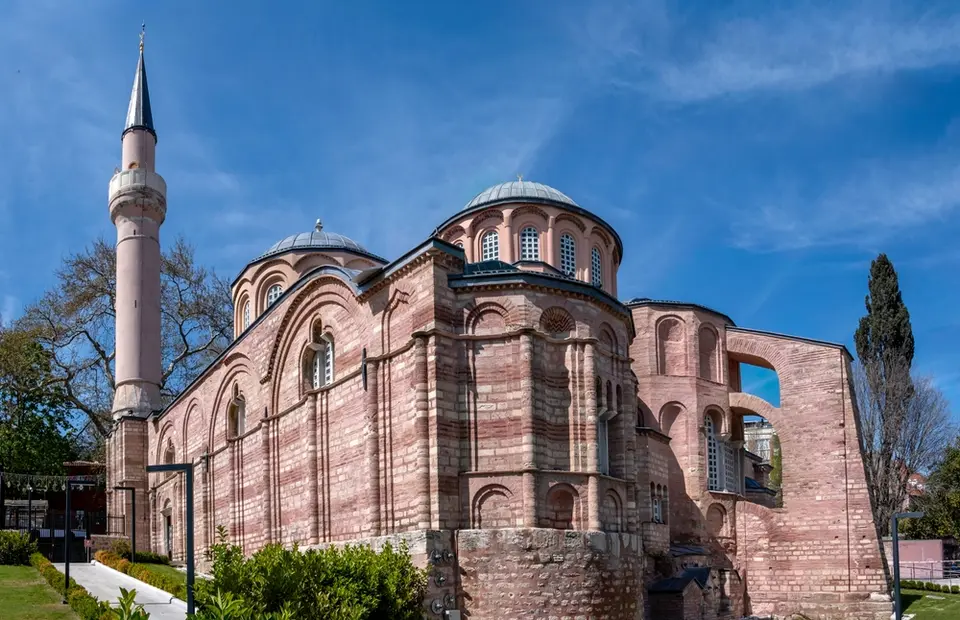
Exterior from the south-east: the apse, the domes and the minaret added after the conversion. 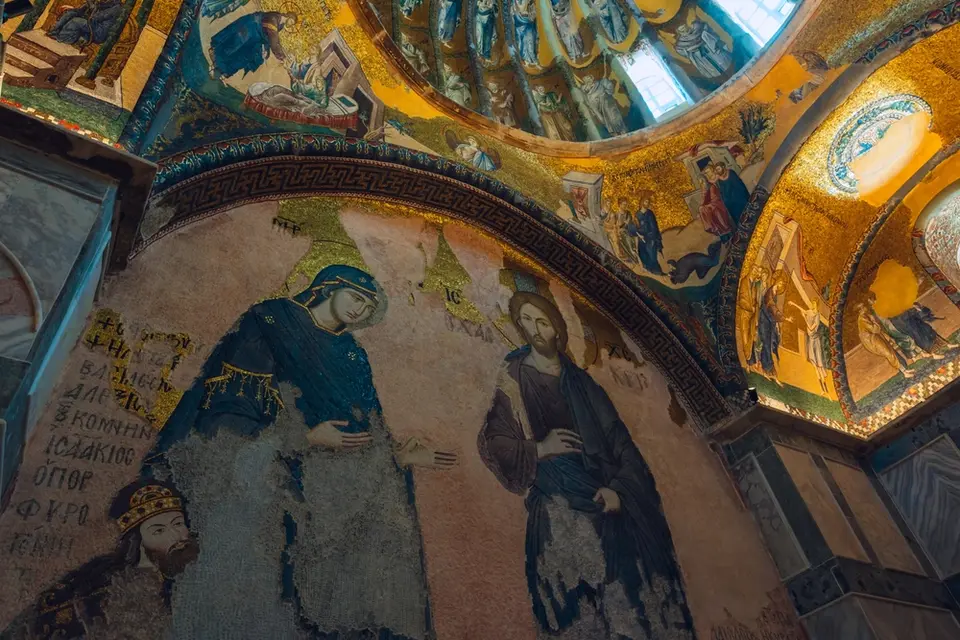
Inner narthex: the Deesis, with Isaac Komnenos kneeling at the lower left and the genealogy dome above. 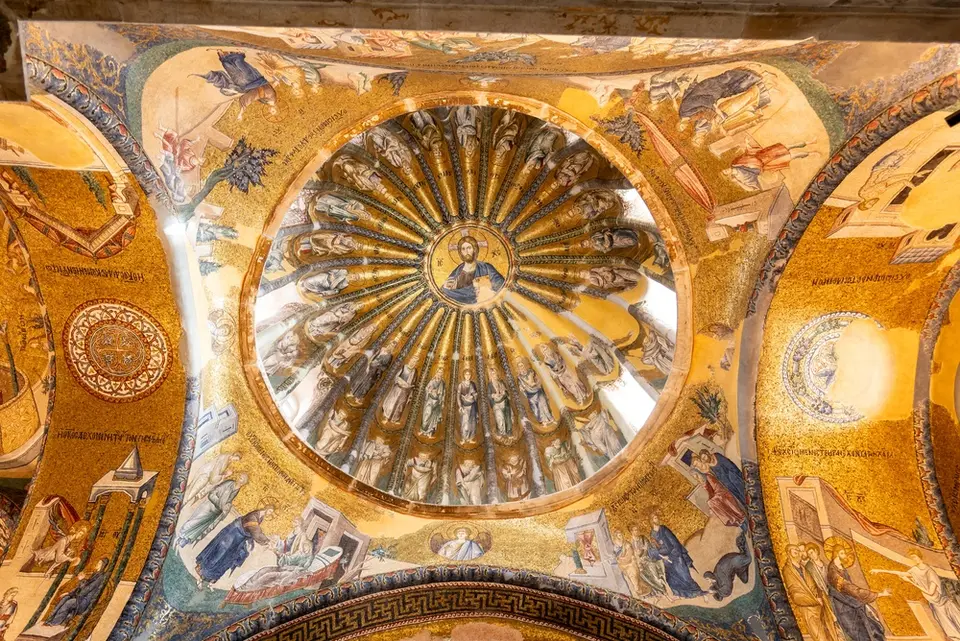
Inner narthex, south dome: Christ Pantokrator in the centre, his ancestors ranged in the flutes. 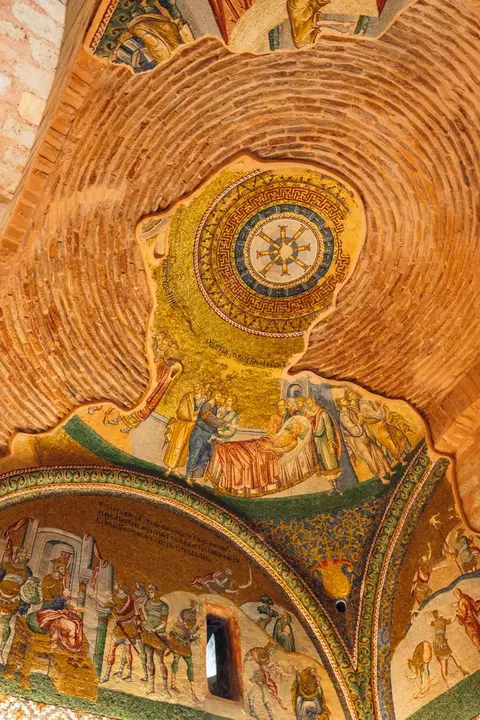
Outer narthex: mosaic survives in patches on the brick vault, above a lunette with an enthroned king and his soldiers. 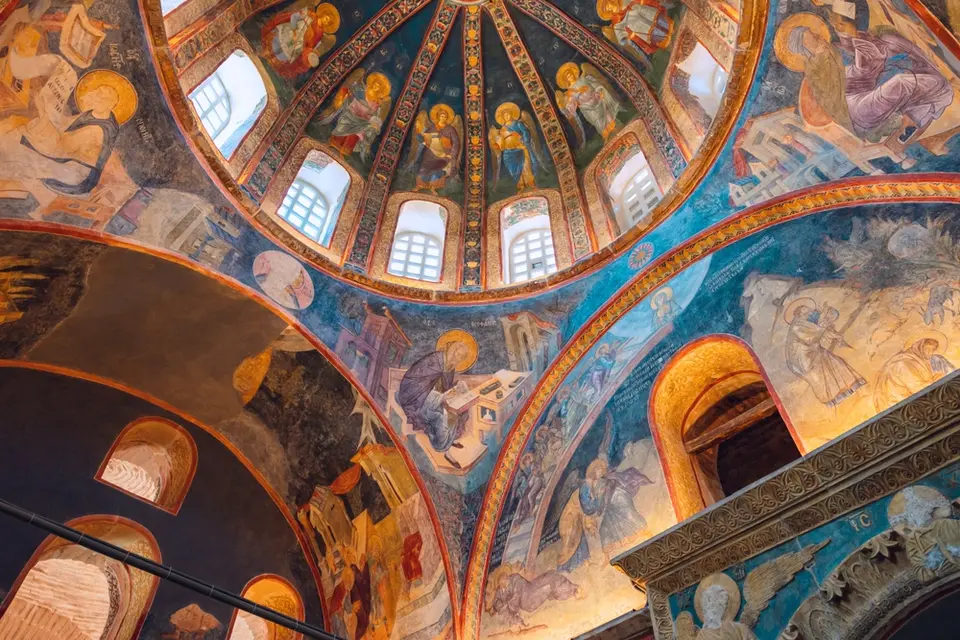
Parekklesion: the frescoed dome, with hymn writers at their desks in the pendentives. 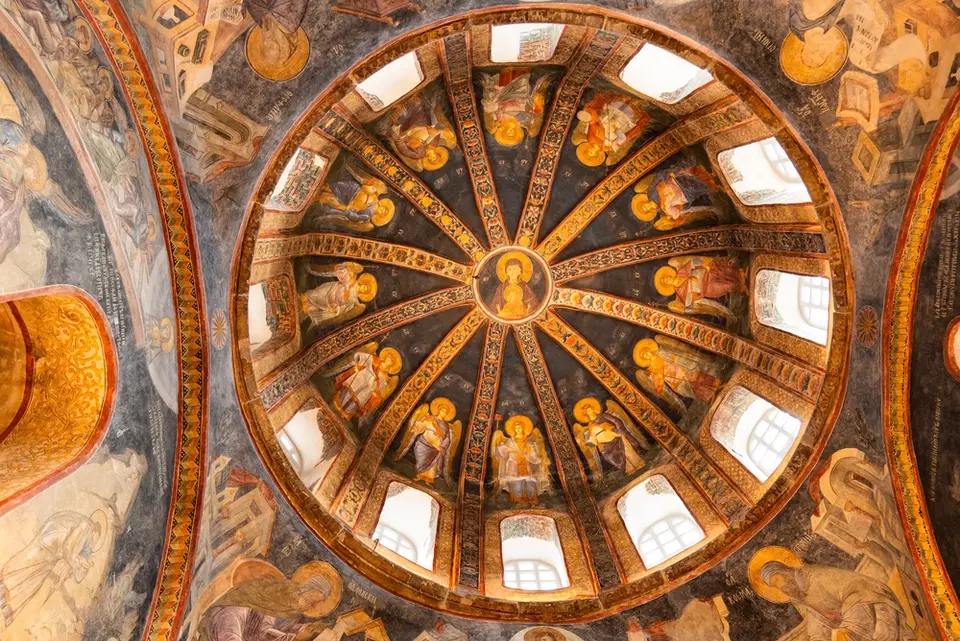
Parekklesion dome from directly below: the Virgin and Child in the centre, angels between the ribs.


Inner narthex: the Deesis, with Isaac Komnenos kneeling at the lower left and the genealogy dome above.
Getting there
Para llegar a la Iglesia de Cora (Mezquita Kariye), toma el tranvía T4 hasta Edirnekapı y camina unos diez minutos. Desde Sultanahmet, toma el tranvía T1 hasta Topkapı y cambia al T4. Desde Taksim, el autobús 87 llega a Edirnekapı. Desde el Cuerno de Oro, usa el tranvía T5 hasta Ayvansaray y sube a pie.
Nearby
Theodosian Land Walls at Edirnekapı
about ten minutes on foot
The fifth-century land walls of Constantinople run just west of the mosque, built as an inner wall, an outer wall and a moat. Edirnekapı is the old Gate of Charisius, the gate Mehmed II rode through after the conquest of 1453.
Mihrimah Sultan Mosque, Edirnekapı
about ten minutes on foot
Mimar Sinan designed this sixteenth-century mosque for Mihrimah Sultan, daughter of Süleyman the Magnificent, beside the Edirnekapı gate. Its walls are pierced by so many windows that the prayer hall is among the brightest Sinan built.
Tekfur Palace (Palace of the Porphyrogenitus)
about ten minutes on foot
A three-storey late Byzantine palace set against the northern end of the land walls, raised in the decades after 1261. It later housed an Ottoman tile workshop and has been a museum since 2019.
More Istanbul landmarks
Hagia Sophia
Our visitor guide to Hagia Sophia, the other great Byzantine interior to pair with a Chora visit.
Galata Tower
Our visitor guide to Galata Tower, for a view back across the Golden Horn to the old city.
Frequently asked questions
Is Kariye Mosque worth visiting?
Yes, if you care about Byzantine art. The building holds mosaic cycles of the lives of the Virgin and Christ and a frescoed funerary chapel, all made between 1316 and 1321. It is small, so a visit takes about 60 minutes, and it sits away from the Sultanahmet crowds.
Is Chora Church worth visiting if you have already seen Hagia Sophia?
Yes. Hagia Sophia impresses with scale. Chora Church (Kariye Mosque) is the opposite: a small building where the mosaics and frescoes are close to eye level and tell complete stories. Many visitors pair the two on the same trip.
Is Chora Church a church, a museum or a mosque?
It was built as the church of the Chora monastery, became a mosque in 1511, was a museum from 1945, and was reconverted to a mosque in 2020. It reopened in May 2024 as Kariye Mosque with a route for visitors.
Is Chora Church open now?
Yes. It reopened on 6 May 2024 after a four-year restoration. Tourist visits run 09:00–18:00 on Saturday, Sunday, Monday, Tuesday, Wednesday, and Thursday. Fridays: worship only, no tourist visits.
Is Chora Church free?
Not for foreign tourists, who pay €20 at the gate. Entry for Turkish citizens is free and for worshippers it is free.
Can non-Muslims visit Kariye Mosque?
Yes. Visitors of any faith can enter with a ticket during tourist hours. You follow the visitor route through the narthexes and the side chapel and respect the prayer area.
What is the dress code at Chora Church (Kariye Mosque)?
Shoulders and legs covered; headscarf for women inside the prayer hall. These are the rules of a working mosque, so plan your clothing before you set out.
How long does a visit to Chora Church take?
Plan about 60 minutes inside. Add time if you want to follow each mosaic cycle scene by scene, and allow for a wait if you arrive close to a prayer time.
Can you see the mosaics now that it is a mosque?
Yes. The mosaics of the two narthexes and the frescoes of the side chapel are on the visitor route. The mosaics in the prayer hall itself are covered, in line with its use for worship.
When was Chora Church built?
A monastery probably stood here by the sixth century. The core of today's church dates from the 11th and 12th centuries. Theodore Metochites rebuilt and decorated it between about 1316 and 1321.
What does Chora mean?
Chora is a Greek word for land or countryside. It points to the monastery's early position outside the walls of Constantinople.
Where is Chora Church and how do you get there?
It stands in Edirnekapı, Fatih, Istanbul, in the north-west of the old city, some distance from Sultanahmet. Most visitors arrive by taxi, public transport or a pre-booked transfer. Our getting-there page lists the routes step by step.
Is the Museum Pass valid at Chora Church?
No. Museum passes are not accepted at Kariye Mosque. You need a separate ticket for this site.
Can you take photos inside Chora Church?
Yes, photography without flash is allowed on the visitor route. Flash is prohibited to protect the mosaics and frescoes.
Ready to see the mosaics?
Pick your date and have the QR ticket on your phone before you leave the hotel.
Sources
- Müze İstanbul (muze.gen.tr) — Chora Mosque visitor information
- Columbia University, Restoring Byzantium — Kariye Camii building history
- Columbia University, Restoring Byzantium — Kariye Camii iconography
- Columbia University, Wallach Art Gallery — Restoring Byzantium: The Kariye Camii in Istanbul and the Byzantine Institute Restoration
- Go Türkiye (official tourism portal) — Kariye Mosque (Chora)
- Dumbarton Oaks — A Truthful Record: Kariye Camii
TicketsPrice shown at checkout